
Register now →
 |
IntroductionThe RLuS-3 training provides a practical introduction to the fundamentals and application of the “Guidelines for the Assessment of Air Quality at Roads Without or With Sparse Roadside Development (RLuS 2023)” as well as the efficient use of the RLuS 3 PC software for estimating traffic-related air pollutant immissions. |
Background information on RLuS 2023 and RLuS 3
The Research Association for Roads and Transportation (FGSV) has further developed the previous RLuS rules and published them as RLuS 2023.
In the General Circular Road Construction (ARS) No. 20/2023 – Subject area 12: Environmental protection / 12.2: Air pollution control, it is recommended that, for immission assessments in accordance with RLuS 2023, the updated calculation program RLuS 3 be used (the former ARS 03/2021 has thus been repealed).
RLuS 3 is a PC-based calculation method for estimating traffic-related pollutant immissions at roads without or with sparse roadside development. It consists of two central program components:
- Emission determination (basis remains: HBEFA; reference years typically 2005 to 2040)
- Immission determination (calculation of concentrations in the roadside environment)
In addition, RLuS 3 (depending on the use case) supports several integrated modules, including:
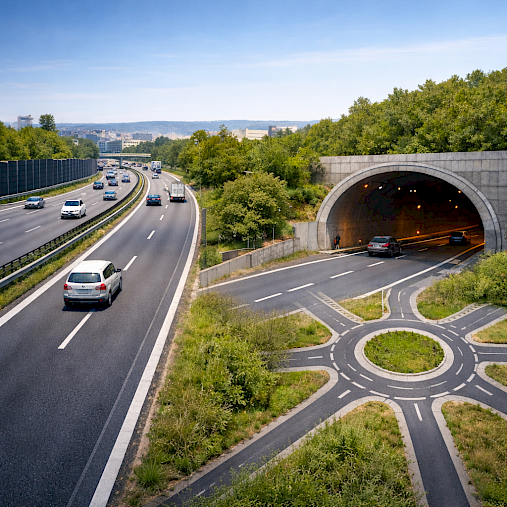
- Tunnel module (immission calculation in the near-field area of tunnel portals)
- Noise barrier module (immission estimation behind noise barriers/berms, typically up to 10 m)
- Intersection module (influence of an intersecting road)
- Roundabout module (evaluate 2-, 3- and 4-arm roundabouts with 90°/120° offset on the immission side)
In addition, key model assumptions and input variables are addressed, e.g. non-exhaust particle shares (wear/resuspension), NO/NO₂ conversion (simplified chemistry model), as well as indicative background concentration values based on comprehensive data approaches.
Training contents
- Classification of RLuS 2023: objectives, scope of application, typical questions in planning/approval, assessments (limit values, 39th BImSchV, EU Directives)
- Fundamentals of emission determination: traffic input, vehicle fleets/reference years, HBEFA reference, relevant pollutants/components (incl. non-exhaust particles)
- Immission determination in RLuS 3: model logic, input parameters, interpretation of results and plausibility checks
- Working with RLuS 3 in practice: software structure, workflows, typical sources of error, documentation of the calculation
- Additional modules and special cases:
- Tunnel portals (tunnel module)
- Noise protection structures (noise barrier module)
- Intersections (intersection module)
- Roundabouts (roundabout module)
- Practical exercises: transparent example calculations and best-practice guidance for project-ready outputs/reports
Participation & information
The training is aimed at engineering consultancies, authorities, specialist planners and expert assessors who prepare, review or document immission assessments in the roadside environment in accordance with RLuS.
You can find all registration details on our page Training courses.
If you have any questions, you can also reach us at info.dd@lohmeyer.de.
Participation and payment terms (PDF)